Why Traditional B2B Campaigns Are Not Enough Anymore


Summary: From Conversion to Decision is a progressive buyer enablement series for B2B marketers. It moves from why traditional campaigns fall short to how to design campaigns that help buyers make real decisions, with downloadable guides, frameworks, and examples along the way. This is Part 1.
Most B2B campaigns are built around a comforting assumption: if we create the right content, put it behind the right CTA, and nurture the buyer toward Sales, momentum will follow.
Download the ebook.
Register for the webinar.
Request the demo.
Convert to MQL.
Move to Sales.
That model is familiar, measurable, and clean to optimize. It also hides a bigger problem.
A conversion is not the same as buyer progress.
A download does not mean the buyer read the asset. A webinar registration does not mean the buying group is aligned. A demo request does not always mean the buyer is ready to decide.
The buyer can take a marketing action without completing the buying work that actually matters. That gap is where traditional campaigns start to break down.
Buyer enablement is the practice of helping buyers complete the decision tasks required to move forward: understanding the problem, comparing options, building requirements, validating risk, aligning stakeholders, and knowing what to do next. It's the through-line in Gartner's buyer enablement research, which frames buying as a set of jobs buyers have to complete, not a funnel they move through.
For example, a buyer enablement asset doesn't just explain why the category matters. It helps the buyer size the problem, compare options, build requirements, validate risk, or align stakeholders.
Buyers do not experience your funnel
Marketing teams typically design campaigns around the stages they manage internally: awareness, consideration, decision, conversion. That structure is useful for reporting. It helps organize content, scoring, and handoffs.
But buyers do not experience your funnel. They experience a sequence of questions they need to answer before they can move forward:
- Is this problem real?
- Is it urgent enough to prioritize?
- What are our options?
- Who needs to be involved?
- What should we require?
- Can we trust this vendor?
- Can we justify the investment?
- How do we get everyone aligned?
Those aren't content needs. They're decision needs. And they don't happen in order.
A buyer may start by comparing vendors, then realize the team never agreed on requirements. They may attend a webinar, then go backward to understand the problem more clearly. They may request a demo, then stall because Finance or IT raises a concern no one has addressed yet.
From the outside, that looks like low intent or a slow sales cycle. More often, the buyer isn't stuck because they lack interest. They're stuck because they haven't completed the next buying job.
B2B buyers now do most of their decision work before they ever talk to Sales. They research independently, compare options, consult peers, read reviews, and increasingly ask AI tools. They pull stakeholders in and out of the process and form opinions long before they raise a hand.
If your campaign doesn't help them answer the next question, they'll answer it somewhere else: a competitor, a peer, a review site, or an AI-generated summary.
The format does not tell you where the buyer is
One reason traditional campaigns struggle is that marketers assign funnel stage based on content format. A blog is top of funnel. An ebook is awareness. A webinar is mid-funnel. A case study is late-stage. A demo is decision.
That makes campaign planning easier, but it creates false confidence. The same asset can serve very different buying jobs depending on the buyer's context.
Why format is a weak signal of buyer stage
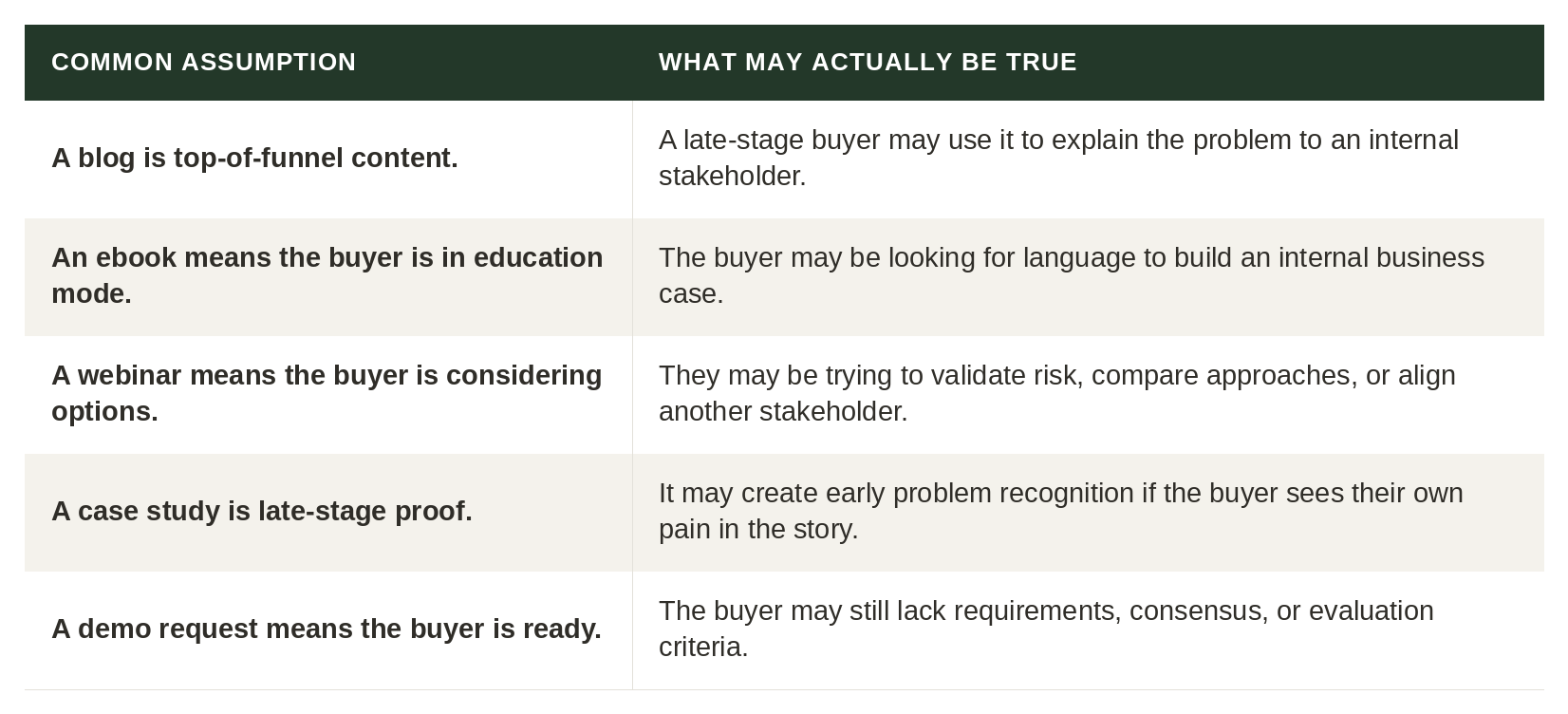
So, asset format is a weak signal of buyer stage.
Buyer enablement is not a content format. It is a design discipline. A blog can be buyer enablement. An ebook can be buyer enablement. A webinar can be buyer enablement. And a sophisticated calculator can fail to be buyer enablement if it doesn't help the buyer complete a real decision task.
The better question isn't "what format is this asset?" It's "what buying job does this asset help the buyer complete?"
Traditional campaigns optimize for response
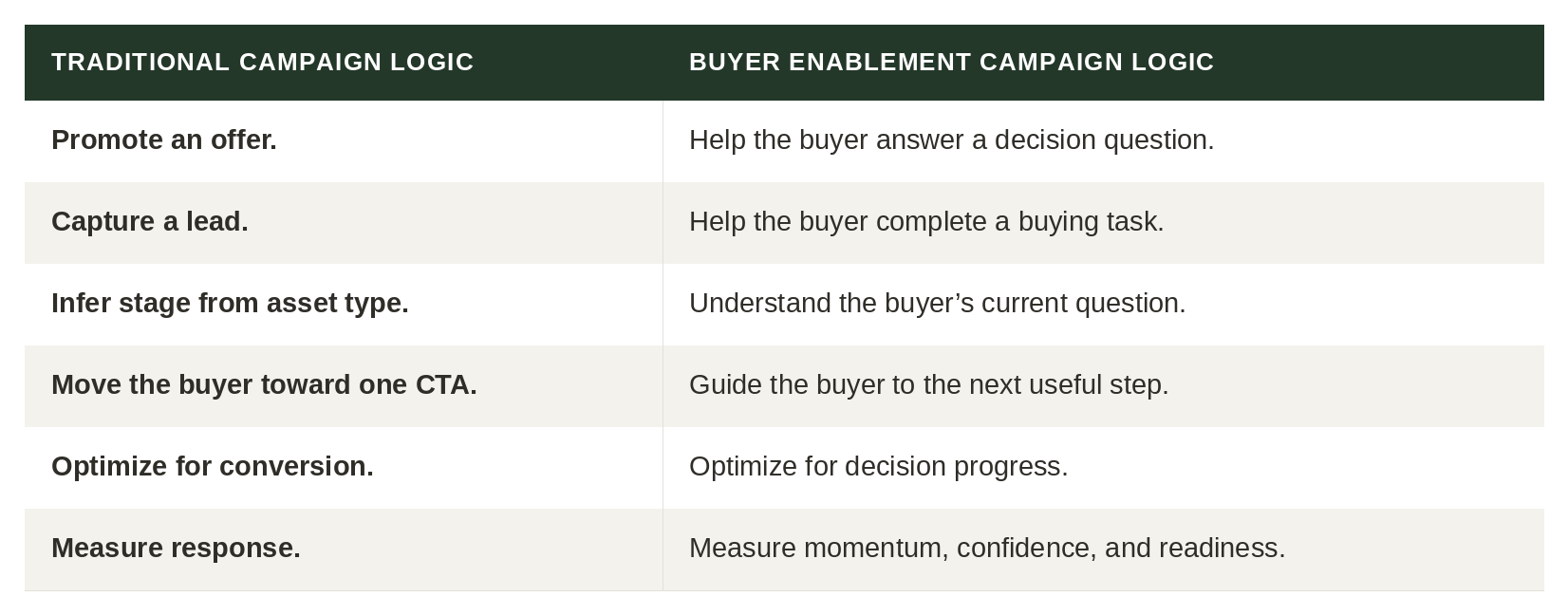
Traditional campaigns are very good at creating response. They drive traffic, capture leads, generate registrations, and create sales handoffs. Those things still matter. The problem is that response is not the same as readiness.
A campaign can look successful by traditional metrics and still leave the buyer exactly where they started. A buyer downloads a "complete guide" but never finds the answer to the internal question they're actually wrestling with. A champion reads a case study but still can't explain the business case to Finance.
That's the gap buyer enablement needs to close.
Buyer enablement changes the design question
Traditional campaign planning often starts with "what asset [product] are we promoting?" or "what action do we want the audience to take?" Buyer enablement starts with a different question: what decision is the buyer trying to make, and what would help them make progress?
That shift changes the content, the CTA, the nurture path, the sales handoff, and what we measure. The campaign is no longer just a sequence of promotional touches. It becomes a guided decision environment.
This is the shift from conversion to decision.
Introducing Decision Rate Optimization
Most marketers already know Conversion Rate Optimization. CRO asks: how do we get more people to take the desired action? Improve the landing page, clarify the CTA, shorten the form, reduce friction. CRO still matters. In complex B2B buying, it isn't enough.
A conversion tells you someone acted. It does not tell you they advanced.
That's why I think B2B marketers need a second lens: Decision Rate Optimization, or DRO. DRO asks: how do we help buyers complete the right decision task and move to the next useful step?
CRO gets the click. DRO earns the next decision.
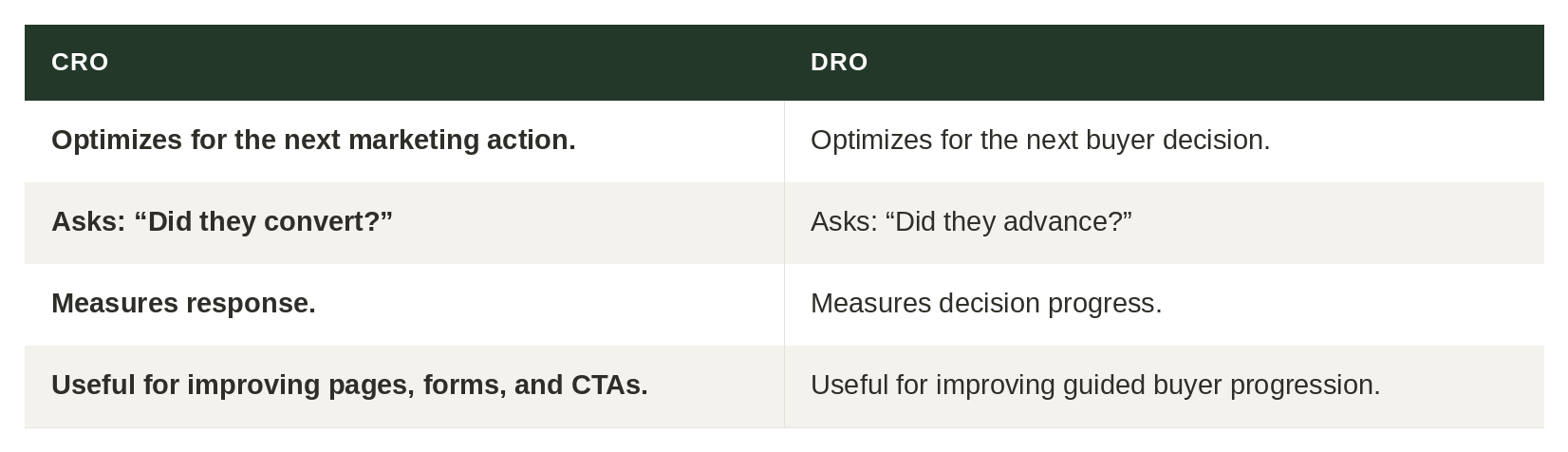
I'll unpack DRO fully in the next article. For now, the important shift is this: campaigns need to optimize for buyer progress, not just buyer response.
There's a related reason this matters. Buying isn't linear. Buyers move forward, but they also go backward to re-clarify the problem and sideways to validate a concern or pull in a stakeholder. A buyer enablement campaign makes room for that movement without turning the experience into a content maze. The goal isn't to offer every asset at once. It's to offer better next choices. I'll cover how to design for that, and how to give buyers control without overwhelming them, later in the series.
Try this before the next article
You don't need to rebuild a campaign to put this idea to work. Start with one asset you already have.
Pick one: a blog post, landing page, nurture email, webinar, case study, or demo CTA. Don't overhaul it. Don't rebuild the journey. Just ask one question: what might the buyer be trying to figure out when they engage with this?
Then add one helpful nudge. A clearer next step. A better question. A short checklist. A prompt to use with their team. A CTA that helps the buyer make progress instead of just taking an action.
I built a simple worksheet for exactly this: The One-Asset Buyer Enablement Experiment. It includes a plain-English guide to the six buying jobs and a 10-minute field test to help you make one asset more useful to a buyer who's trying to decide.
Closing thought
If your campaign only asks "how do we get the buyer to convert?" it can create activity without momentum. A better question is: what decision is the buyer trying to make, and what would help them move forward with confidence?
That's the difference between a campaign that captures attention and a campaign that supports buying. And it's the shift from conversion to decision.
Thanks for reading and stay curious.
Jayme Jenkins is a senior marketing leader who helps B2B SaaS and enterprise technology companies move from fragmented marketing activity to buyer-led growth systems. Her work focuses on GTM strategy, AI-enabled workflows, measurement clarity, and teams that own the work.
Follow the series.
From Conversion to Decision walks through how to move from conversion-focused campaigns to buyer enablement campaigns that help buyers make progress. Across the series we'll cover why CRO gets the click but DRO earns the next decision, how to build a buyer decision spine that supports many campaign paths, how buyer enablement campaigns differ from traditional ones, and how to start with the assets your team already has.
You'll also get the working tools as they publish: guides, frameworks, and examples you can download and use with your own campaigns.
Start with The One-Asset Buyer Enablement Experiment, then subscribe so you don't miss the next one.
Next up: CRO Gets the Click. DRO Earns the Next Decision — where I'll show how to measure whether buyers are actually advancing, not just converting.