Start With the Gap, Not the Asset


Summary. AI makes it easier than ever for a lean marketing team to produce more, and that's exactly the trap. This article shows how to diagnose the gap slowing growth before building anything, what to build first for the five most common gaps, and how one strong idea can compound across sales, marketing, and customer success. Includes a diagnostic table with a downloadable PDF.
How lean B2B marketing teams decide what content to build first
When a lean marketing team is overwhelmed, the instinct is to produce more.
More one-pagers. More decks. More case studies. More nurture emails. More thought leadership. More sales enablement. More campaign assets. More versions of the same message for every channel, stakeholder, product line, and quick request that shows up in Slack.
That instinct makes sense. It's also usually wrong.
The problem usually isn't that the team is producing too little. It's that the team is producing without a clear diagnosis of what the business needs next, what the buyer is trying to do, and which content gaps are actually slowing growth.
I was talking with a team recently who's living this right now. Their company decided marketing is the next growth lever, which is great news and a lot of pressure at the same time. Suddenly everyone has content needs, every request feels urgent, and the list of things to build is growing faster than the team is.
That's the trap small teams fall into. Not because they're careless. Because they're helpful.
They become the place every request goes. From the outside, the work looks productive. Stakeholders are getting answers. Assets are being shipped. The content library is growing.
But underneath that activity, the same problems keep showing up.
Sales is still improvising in high-intent conversations. Buyers still can't find the information they need on the website. Leads still go stale because follow-up depends on a person remembering to do it. Customer signals still sit buried in calls, tickets, notes, and account history.
So the answer isn't to build more.
The answer is to build less, in the right order.
Two frameworks helped me see the problem differently
Two resources have shaped how I think about this: Gartner's buyer enablement work and Shiv Narayanan's content roadmap thinking at How to SaaS.
I like Gartner's buyer journey work because it starts with the buyer's job, not the marketer's channel. B2B buyers aren't moving through a neat, linear funnel. They're trying to understand the problem, explore solutions, build requirements, compare suppliers, validate the decision, and create consensus with other stakeholders.[^1] The work of marketing and sales is to help them complete those jobs with more confidence and less friction.
I like Shiv's How to SaaS content-roadmap approach because it looks at the problem from the other side. It asks marketing teams to stop building random content and work backward from business priorities, revenue opportunity, funnel inefficiency, and buyer-journey gaps.[^2] In other words: don't start with "what asset should we make?" Start with "where is growth getting constrained?"
Those two ideas work together.
Gartner helps you understand where buyers are stuck. Shiv helps you decide what to build first. AI helps a small team make that system easier to run, but only if the team has already made the right strategic choices.
That last part matters.
AI makes it easier than ever to produce more content. But if the underlying system is wrong, AI just helps you create more of the wrong things faster.
A lean team doesn't need a bigger pile of assets. It needs a sharper starting point.
The 5% need help buying now. The 95% need help getting ready.
This is where the 95/5 rule becomes useful.
The idea, popularized in B2B by the LinkedIn B2B Institute, is that only a small share of your market is actively shopping at any given time, while the much larger share is out of market today. Treat the exact number as a heuristic, not a law. It varies by category, buying cycle, and market. But the strategic point holds: most of your future buyers aren't ready to buy right now.
That creates a real tension for lean teams.
If you only build for the 5% who are active today, you may help sales close what's already in motion, but you'll eventually starve the future pipeline. If you only build for the 95% with broad thought leadership, you may create visibility, but sales will still struggle to move active buyers through real decisions.
This is why "build less" can't mean "only build bottom-funnel assets."
It means build with a better sequence.
The 5% need decision support now. They need comparison, validation, proof, ROI logic, implementation clarity, and internal consensus material. The 95% need education, category clarity, problem framing, cost-of-inaction thinking, and memorable points of view that help them recognize the problem before they enter an active buying cycle.
A small team can't serve both groups by producing endlessly.
It serves both groups by designing content around the buyer's decision, then adapting the same core thinking across the moments where that decision develops.
Start with the gap, not the asset
Before you create anything, get honest about the one gap that's costing the business the most right now.
Not the loudest request. Not the most visible project. Not the content idea everyone already agrees would be nice to have.
The actual gap.
Where are buyers getting stuck? Where is sales losing momentum? Where is the website failing to answer the questions buyers already have? Where is customer success seeing signals nobody is acting on? Where is marketing creating engagement that never turns into movement?
Marketing can't fix everything at once. On a lean team, trying to fix everything is how you end up busy and ineffective.
Diagnose before you design.
Here's a practical way to find your starting point. In every case, the best source material is usually closer than the team thinks: buyer research, win-loss analysis, customer interviews, sales calls, support themes, website behavior, and the customer language your team already hears every week. AI should not add more work to the system. It should help turn that raw material into the few assets buyers actually need.
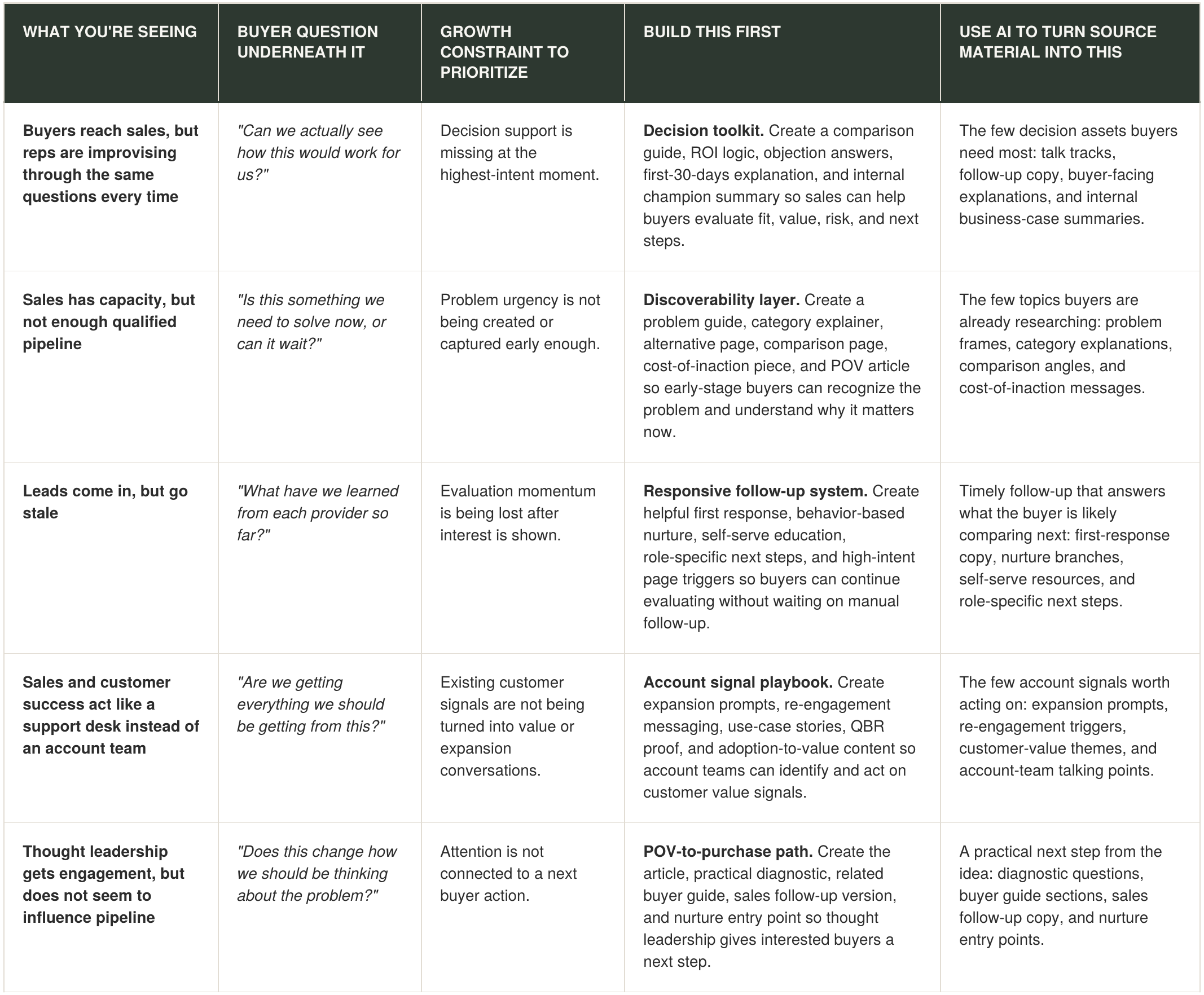
The point isn't to work the whole table at once.
The point is to name the one row that looks most like your business right now.
That's your starting point.
If buyers are already talking to sales, help sales sell first
If buyers are reaching sales but reps have nothing to guide a real conversation, your gap is at the bottom of the funnel.
Reps are in the highest-intent moments. They're answering the same questions differently. They're trying to explain value from memory. They're helping buyers compare options, validate the decision, and build internal confidence without the right tools.
That's not a content-volume problem. It's a decision-support problem.
Start there.
Build the small decision toolkit a rep actually needs. The comparison. The ROI logic. The objection answers. The "what happens in the first 30 days" explanation. The internal summary a champion can forward after the call.
Not another product overview.
The product overview may tell buyers what you sell. The decision toolkit helps them decide whether the change is worth making, whether your approach is credible, and how to explain the decision to the other people involved.
AI can help here, but not by generating ten more one-pagers. It helps by taking one strong core idea and adapting it for the moment it's used: the version a rep walks through live, the version a buyer reads alone, the version a champion forwards internally, and the version that belongs on the website.
Same thinking. Different moments.
If pipeline is thin, make your best thinking discoverable
If sales has capacity but not enough pipeline, your gap is earlier.
But it's still buyer-led.
The people who will eventually buy from you may already be trying to understand the problem. They may be searching for alternatives. They may be comparing approaches. They may be reading AI-generated summaries before they ever reach your site. They may be forming their mental shortlist long before they're ready to talk to sales.
Gartner's 2026 sales research adds urgency here: 67% of surveyed B2B buyers said they prefer a rep-free experience.[^3] That doesn't mean sales matters less. It means buyers are doing more of the early work without you.
If your best thinking only exists in sales decks, internal docs, PDFs, or one-off conversations, the buyer can't find it.
That's where many teams create a hidden pipeline problem. They have good thinking, but it's not discoverable. They have useful sales material, but only for people who have already raised their hand. They have smart product marketers and sellers explaining the category every day, but none of that explanation is available to the 95% who are still learning.
Start by making your best thinking public and useful.
That may mean a category explainer. A problem guide. A comparison page. A cost-of-inaction article. A buyer checklist. A point of view that helps the right person recognize the problem and understand what to do next.
AI can help identify the questions buyers are already asking. It can summarize sales calls, cluster objections, find repeated language in CRM notes, and turn subject-matter expertise into a first draft faster than a small team could on its own.
But the starting point is still the buyer's problem.
Not the channel. Not the content format. Not the campaign calendar.
Lead with the buyer. The channels are a consequence of the design, not the design itself.
If leads are going stale, build the follow-up system
If leads are coming in but going stale, your gap is follow-up.
Good leads are dying in a slow, manual process because a human is the only path forward. Someone has to notice the behavior, decide what it means, write the follow-up, send the next resource, and remember to check back later.
That's fragile on any team. It's especially fragile on a lean team.
The answer isn't always "send more emails." It's to build a follow-up system that keeps helping the buyer when your team can't.
What should a buyer receive after they download the guide? What should happen if they visited the pricing page but didn't convert? What should they see if they engaged six months ago and came back this week? What should change if the buyer looks like a practitioner, an executive, a technical evaluator, or an existing customer?
This is where nurture should stop feeling like a drip campaign and start acting like buyer support.
AI can help summarize behavior, segment likely intent, personalize the next message, and draft paths based on what the buyer has already done. But it shouldn't invent the strategy. The team still needs to define the buying signals that matter, the questions each signal implies, and the next helpful thing to send.
If the system is designed well, follow-up becomes less dependent on memory.
The buyer keeps moving, even when your team is small.
If the existing base is quiet, look for signals you already own
If sales and customer success are running like a support desk instead of an account team, your gap may be in the existing base.
Ready-to-buy signals may already be sitting inside accounts you have.
A customer asked about a feature twice. A support pattern changed. A usage milestone was hit. A new stakeholder joined. A team expanded. A renewal conversation exposed a bigger business problem. A customer solved one use case and is clearly ready for the next one.
But nobody sees the signal because the work is fragmented.
Sales has one view. Customer success has another. Support has another. Marketing has another. The buyer's actual story is split across systems and conversations.
Start by giving sales and CS a shared view of the moments that matter. Then build the content to act on those moments.
That might include expansion prompts, re-engagement messages, use-case stories, executive check-in language, QBR proof, or internal talking points that help the account team connect the signal to a business conversation.
AI helps by pulling patterns out of the data you already own. It can summarize calls, cluster support themes, flag account changes, and turn customer language into useful messaging.
But the strategy is still human.
Know which signals matter. Know who should act. Know what buyer need the content is supposed to support.
Build one idea to serve multiple groups
This is the part most teams miss.
The same content can help buyers, sales, customer success, and marketing engagement if it's designed around the buyer first and then adapted for the right moments.
That's different from repurposing.
Repurposing usually starts with a format. We wrote an article, so now we need a LinkedIn post, an email, and a slide.
A buyer-led content system starts with the decision. What is the buyer trying to understand? What risk are they trying to reduce? What internal conversation do they need to have? What proof would help them move forward?
Once that's clear, the same core idea can serve multiple groups.
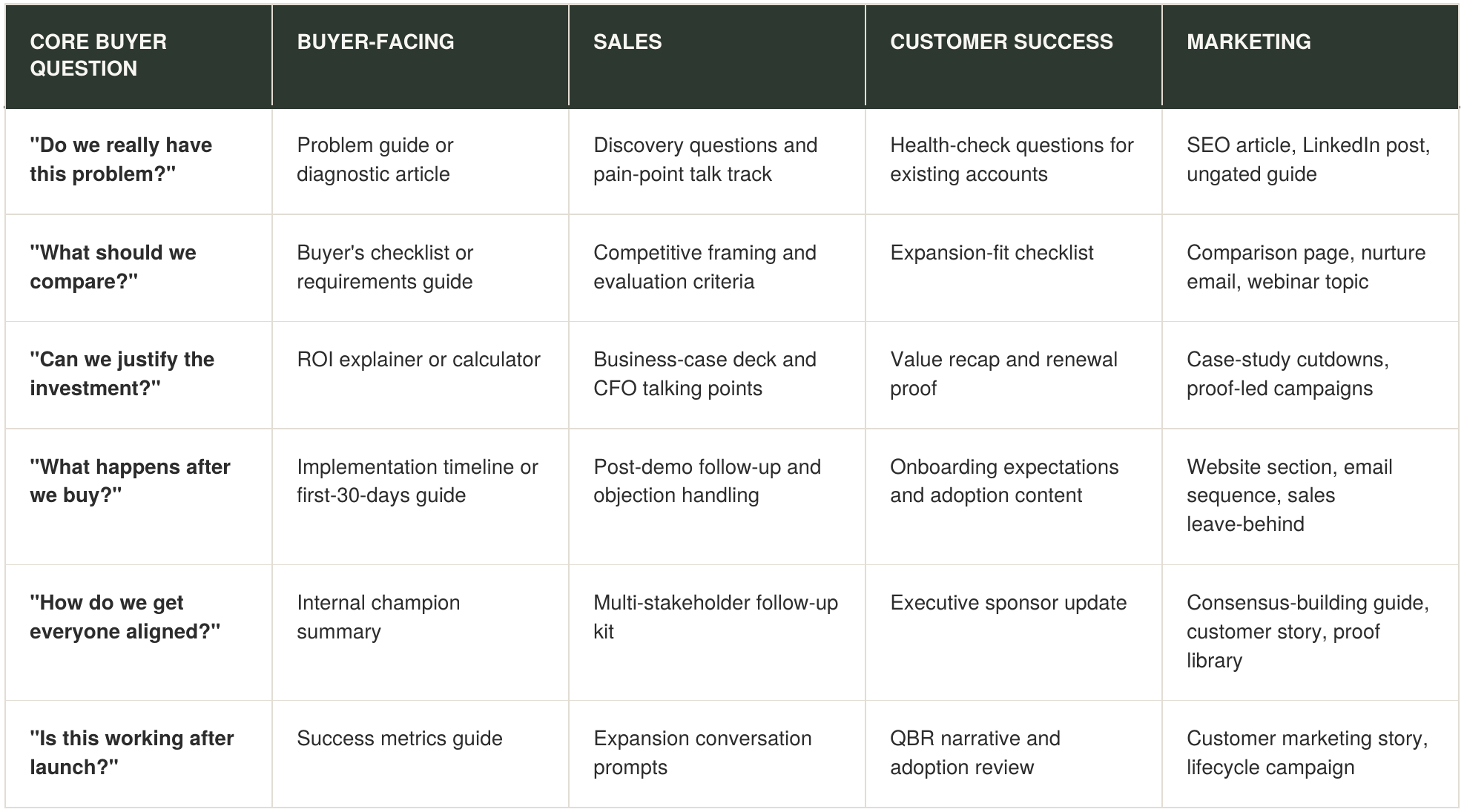
This is how a small team creates leverage.
One strong idea becomes the spine for multiple moments. The buyer gets clearer information. Sales gets better conversations. Customer success gets more proactive account motions. Marketing gets discoverable, reusable, engagement-driving content without starting from scratch every time.
That's the difference between content as output and content as infrastructure.
Build for compounding, not volume
The reason most lean teams stay underwater is that every asset is spent the moment it's sent.
A PDF goes to one rep for one deal, and then it disappears. A deck gets built for one product launch, and the structure never gets reused. A nurture email gets written once, but nobody turns the logic into a reusable framework. A customer story gets published, but the proof points aren't organized by use case, objection, segment, or buying stage.
That's the opposite of leverage.
The fix is to build things that keep paying out.
One asset idea, designed to work across channels and teams. One buyer problem, translated into sales, website, nurture, and customer-facing versions. One reusable template your team can use the next time a solution launches.
This is where AI earns its place.
Not as a machine for producing more. As a way to make the system easier to run.
AI can help turn a sales conversation into a website section. It can turn a webinar into a nurture path. It can turn a customer call into an objection library. It can turn scattered notes into a shared set of buyer questions, proof points, and decision criteria.
But only if the thinking is strong first.
Weak positioning gets weaker when you scale it. Unclear buyer logic gets more confusing when you personalize it. Random content becomes a bigger random content problem when AI helps you produce it faster.
So build the thinking once. Build it well. Then let the system carry it.
One rule to keep you honest
When you're deciding what to build first, I come back to one rule:
Help sales sell first, then build the marketing assets.
Sales will start dialing tomorrow. It takes weeks for marketing content to get noticed.
That doesn't mean sales enablement is always more important than demand generation. It doesn't mean you ignore the 95% of the market that isn't ready to buy. And it definitely doesn't mean thought leadership doesn't matter.
It means that when you're truly resource-constrained, the fastest return is often the asset that helps a person have a better buyer conversation this week.
Then you make that asset discoverable.
You turn it into website content. You turn it into nurture. You turn it into a practical article. You turn it into a customer-success prompt. You turn it into a reusable framework. You let it compound.
That's the move.
Not sales enablement over marketing. Not demand generation over customer marketing. Not AI over human judgment.
The move is to start with the gap, build the smallest useful thing that helps buyers move, and design it so the same thinking can work across the system.
None of this requires a big team or a big budget.
It requires the discipline to name the gap that matters, start the system there, and build things that compound instead of things you spend.
Build the system, not just the asset.
Thanks for reading and stay curious.
Jayme Jenkins is a senior marketing leader who helps B2B SaaS and enterprise technology companies move from fragmented marketing activity to buyer-led growth systems. Her work focuses on GTM strategy, AI-enabled workflows, measurement clarity, and teams that own the work.
[^1]: Gartner describes modern B2B buying as nonlinear and organized around buying jobs rather than a neat funnel. Public Gartner materials identify buying jobs including problem identification, solution exploration, requirements building, supplier selection, validation, and consensus creation.
[^2]: Shiv Narayanan's How to SaaS content roadmap approach emphasizes tying content to strategic priorities, exploring revenue opportunities, connecting content to financial targets, assessing funnel efficiency, and addressing buyer-journey gaps.
[^3]: Gartner's March 2026 sales survey reported that 67% of B2B buyers prefer a rep-free experience. Gartner also argues that sales enablement must move beyond static content toward AI-powered buyer support.